
Elden Mk15 car-by-car histories
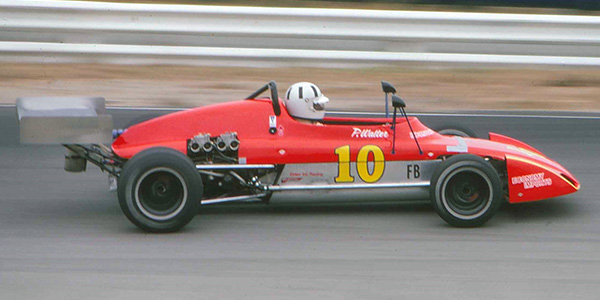
Pat Walter in his Formula B Elden Mk15 at Laguna Seca in June 1974. Copyright Bob Moffett 2026. Used with permission.
The Elden Mk15 was Elden's offering for Formula 3 and Formula Atlantic in 1974, based on the same monocoque as the 1973 Mk12. Only two were built: one appeared in German and later British F3, and the other in SCCA Formula B. Results in F3 were poor, but Pat Walter managed to finish third in the SCCA's Northern Pacific Division.
Peter Hampsheir had been designing and racing his own cars since the early 1960s, initially for Formula 4 using the Briham name. In 1968, Peter and his brother Brian then created a company with John Thompson and his son Peter to create Formula Ford cars under the Elden name. The first of these was the Elden PRH6 - or Mk6 - in 1969. Over the years, 'PRH' and 'Mk' were used interchangeably as the prefix for model names. John Thompson then died, so the brothers had to start again. The Brise family then entered the Elden story when John Brise agreed to finance a new Formula Ford design for his son Tony, the future F1 star. Tony Brise drove the new Formula Ford Elden Mk8 (PRH8) and was highly successful, especially at Brands Hatch where he won the Townsend Thoresen FF1600 championship.
Brise's high profile led to a flood of orders that the brothers initially struggled to fulfil. The Mk8 evolved into the Mk10 by mid-1972 and both sold in huge numbers, mostly for export to the USA. New premises were acquired at Wrotham, near Brands Hatch, and Design Formula (Wrotham) Ltd was created. A moment of particular success came in late 1972, when Ian Grob's team of three Formula Ford Elden Mk8s for Grob, Buzz Buzaglo and Johnny Gerber financed new bodywork designed by former March aerodynamicist Dennis Falconer. This was protested by other teams, but unsuccessfully, and Gerber won the Formula Ford World Cup. Falconer went on to design bodywork kits for March and Brabham chassis in F3 and Formula Atlantic.
Margins in Formula Ford were narrow, and the Hampsheir brothers were keen to move up the ladder. A one-off Formula 3 Mk9 (PRH9) was built on a modified Mk8 chassis in 1972 and showed promise, so a batch of six monocoques was ordered from Arch Motors in 1973 to fulfil the brothers' F2, F3 and Formula Atlantic ambitions. The first three were finished as PRH12s in 1973, with two more becoming PRH15s and the last becoming the PRH16 in 1974. Although the PRH12 was nominally a F3 car - and two cars were raced by Elden's production manager Mike Catlow in the category - the third was built as a Mk12B for Formula B. Of the two 1974 PRH15s, one was completed as a F3 for Steve Farnsworth in the German F3 series and the other as a Formula B for Pat Walter to drive in SCCA Formula B in the USA. The PRH16 was intended for Tony Brise to drive in Formula 2 but was finished instead as a Formula Atlantic car for Gordon Smiley. In total, four of the Eldens built from that six-chassis Arch Motors batch reached the USA for SCCA Formula B, C or Atlantic: Terry Annis had a second-hand ex-F3 Mk12 for Formula C; James Oppermann a new Mk12 for Formula B; Pat Walter the new Mk15 and Bruce Kramer the ex-Smiley Mk16.
If you can add to our understanding of these cars, or have photographs that we can use, please email Allen at allen@oldracingcars.com.
Built for Formula 3 in 1974, and entered for Steve Farnsworth (Ramstein Air Force Base, Germany) to drive in German F3 races that season. It was also driven by Bertram Schäfer at the high-profile "Good Year-Pokal" at the Nürburgring in June. When Schäfer drove it, it was said to have a BMW engine, but at other races with Farnsworth it had a Neil Brown Ford twin cam engine. Farnsworth had no success with the car, and it returned to Elden. In mid-1975, Tim Brise, brother of Tony Brise, had a few races in it, but it was handling so badly at Cadwell Park that he packed up and went home. After failing to qualify for the British GP support race, Brise followed his brother and moved to the works Modus team. Subsequent history unknown, but in 2018 the car was restored and being raced by Edward Clayson. Raced by Clayson in the HSCC Classic F3 race at Silverstone in October 2021.
Driven by: Steve Farnsworth, Bertram Schäfer and Tim Brise. First race: Wunstorf, 9 Jun 1974. Total of 10 recorded races.
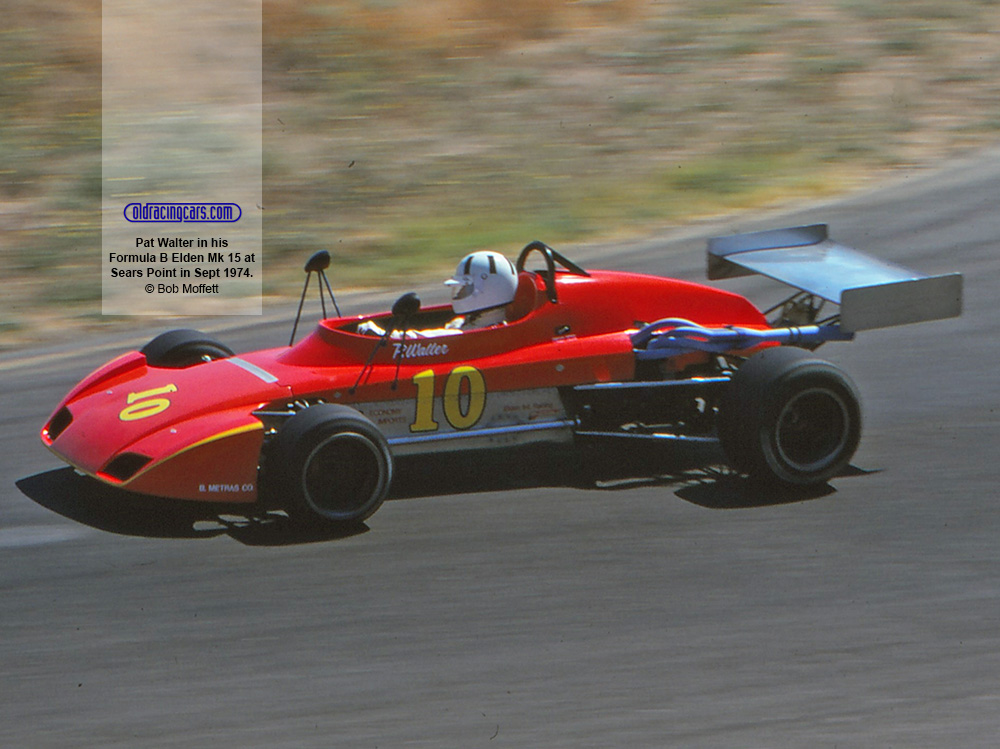
Pat Walter in his Formula B Elden Mk15 at Sears Point in September 1974. Copyright Bob Moffett 2026. Used with permission.
New to Pat Walter (San Rafael, CA) and raced in Northern Pacific Division Formula B SCCA Nationals in 1974. After starting the season in a Formula Ford Royale, he was sixth overall (and fourth in Formula B) at the Laguna Seca June Sprints, won the FB class at the SCCA National at Seattle in June, and was second in class at Portland's Rub-A-Dub Grand Prix in August. He retired from the last National of the season at Sears Point in September, but had done enough to finish third in the division and qualify for the Runoffs at Road Atlanta on 1 November. He finished a highly-creditable sixth, but did not continue with the Elden for 1975, preferring a new Ralt RT1. The Elden was not seen in 1976, but was almost certainly the Elden Mk15 raced by Donald Clark (Carmel, CA) in SCCA Regionals at Sears Point and Riverside in 1977 and 1978. Chris Townsend notes that the car was with Maurice and Darrell Oetken (Reno, NV) in 1980. Subsequent history unknown.
Driven by: Pat Walter and Donald Clark. First race: Laguna Seca, 30 Jun 1974. Total of 7 recorded races.
Decline and fall
In January 1975, Elden announced that all was well and that the company was in fine financial health ... before also announcing that it was being put into liquidation. A new entity, Elden International Racing Ltd, attempted to carry on fulfilling the same orders from the same premises with the same directors and staff. The new models for that year were the Mk17 Formula Ford and a Mk18 for the newly introduced Formula Ford 2000. The factory Mk17 was driven by Tiff Needell and the fearless British champion skier Davina Galica, who was then dabbling in motor racing. However, Needell later described the Mk17 as "a disaster" and there were few sales. It appears that Frank Bradley's Mk17 was converted into a FF2000 car.
In September 1975, it was announced that Bradley had taken a financial interest in Elden International Racing Ltd. Brian Hampsheir remained managing director, Mike Collier took over production, and Syd Fox was appointed test driver. The Mk17 and Mk18 remained the company’s offerings for 1976. New Mk18s were built for Jock Robertson, Roger Orgee and Richard Dutton, and Elden also fielded cars for Bradley, Fox and Ann Moore. Robertson’s Mk18 was returned to the factory after a single race as “not completed to our satisfaction”. Moore, an Olympic silver medallist in show jumping, was the most heavily publicised of the Mk18 drivers, but retired from the sport after only a few weeks of quite poor results. Galica then took over Moore's Mk18, and Mo Harness also drove a Mk18 that season. In total, six Mk17s and ten Mk18s were built between 1975 and 1977.
For 1977, Elden proposed Mk21 FF1600 and Mk22 FF2000 designs, but there was little interest. Bradley fielded one of the Mk18s for Elden employee Ashley Ward early in the season, upgraded to “Mk22” specification, and other Mk18s continued to appear in FF2000, although only Rick Gorne impressed. Aside from the occasional Mk10 in minor Formula Ford races, the Elden name had largely faded away by the end of the year. In October 1977, even Bradley abandoned the “Mk22” in favour of a new Reynard 77SF.
Brian Hampsheir subsequently bought back his share of the company from Bradley but sold the business soon afterwards to Howard Drake. Based in Dartford, Drake produced Eldens for the UK market from 1978 to 1980, although his only notable sales were to the Brands Hatch driving school. After departing Elden, Brian Hampsheir joined forces with Alan Weller to produced cars in Wrotham using the Saracen name. The 15 cars produced were mainly sold in the US.
The Hampsheir brothers reacquired the Elden name in June 1980 and announced an ambitious range of new designs for 1981, designated Mk24 to Mk29. In practice, projects were abandoned and designations reused, and when the marque was relaunched again in 1988 the planned models were PRH27 Formula Ford, PRH28 Formula Renault and PRH29 Formula Ford 2000. Brian’s sons Tony and Graham later became involved through their Tracer Racing concern. By 2026, the Elden Racing website had retrospectively reassigned all type numbers from Mk19 onwards to incorporate the Saracen production.
Acknowledgements
Paul Pfanner was an Elden enthusiast and his first newsletter from the Elden Register, USA in March 1989 has been a good guide to the company's history. My thanks also to Chris Townsend for his notes on the Pat Walter car, and to Bob Moffett for his photographs.
If you can add to our understanding of these cars, or have photographs that we can use, please email Allen at allen@oldracingcars.com.
These histories were last updated on .