
MRE '74A' (Formula Atlantic) history
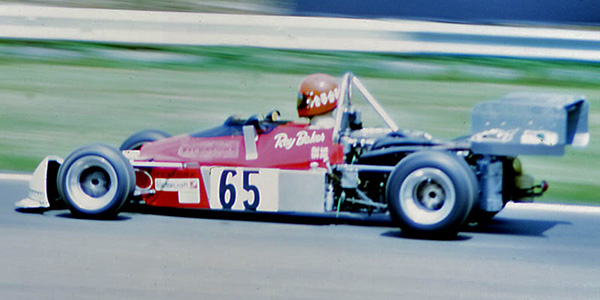
Roy Baker in the Formula Atlantic MRE at Brands Hatch on 20 July 1974. Copyright Gerald Swan 2017. Used with permission.
Designed by Max Boxstrom and built by Jim Gleave's MRE company, the MRE 74A was a Formula Atlantic variant of the Formula Ford 74F. Only one was built, and it did not prove competitive in British Formula Atlantic in 1974. It was not seen again after that season.
Swedish by birth and Canadian by upbringing, Max Boxstrom moved to England in 1965 and studied vehicle aerodynamics at Manchester University with Frank Costin and learned chassis construction working for Trojan in Croydon. In 1969, he was part of Tony Kitchiner's design team on the Kitchiner K2 monocoque Formula 3 car, and was then responsible for the NEMO F3 design for Brendan McInerney's Race Cars International in 1970. A few years later he formed Competition Wheels with partner Mike Knight (at 361 Bath Road, Slough) to supply one-piece magnesium wheels under the DYMAG brand to Formula 1 teams. In 1973 his projects included a stint at Frank Williams' F1 team redesigning the cars' front suspension.
Jim Gleave's Motor Racing Enterprises, now known as MRE (Racing Services) Ltd, was based in Bourne End in Buckinghamshire. MRE's main focus had been on racing car preparation, and it had gradually expanded into manufacturing its own uprights, wheels and other components. In August 1972, Gleave decided to start building complete cars, with the first being designed by Boxstrom for 1973 as a Formula Ford design that could also be used in Formula 3 with minimal modifications. The chassis was a spaceframe with stressed undertray, as required by Formula Ford rules. The basic layout of the suspension was entirely orthodox, but the car used inboard rear brakes, cast magnesium uprights and cast aluminium hubs. Both the FF and F3 designs utilised the same Hewland Mk 9 gearbox, but they differed in fuel capacity, the FF carrying five gallons and the F3 ten. The first Formula Ford car, called the Mk 1 but soon better known as the 73F, was sold to Colin Emery, and the Mk 2 Formula 3 was driven in 1973 by Barrie Maskell and Mike Tyrrell. Further 73Fs were sold in the UK to Roger Orgee, Colin McLean, Chris Skellern and American Ron Fedele.
For 1974, MRE (Components) Ltd announced two Boxstrom designs, the 74F for Formula Ford costing £1,800 for a rolling chassis, and the 74A for Formula Atlantic costing £3,500, less engine. The only Formula Atlantic example to race was for Roy Baker. No details were released of the car.
If you can add to our understanding of these cars, or have photographs that we can use, please email Allen at allen@oldracingcars.com.
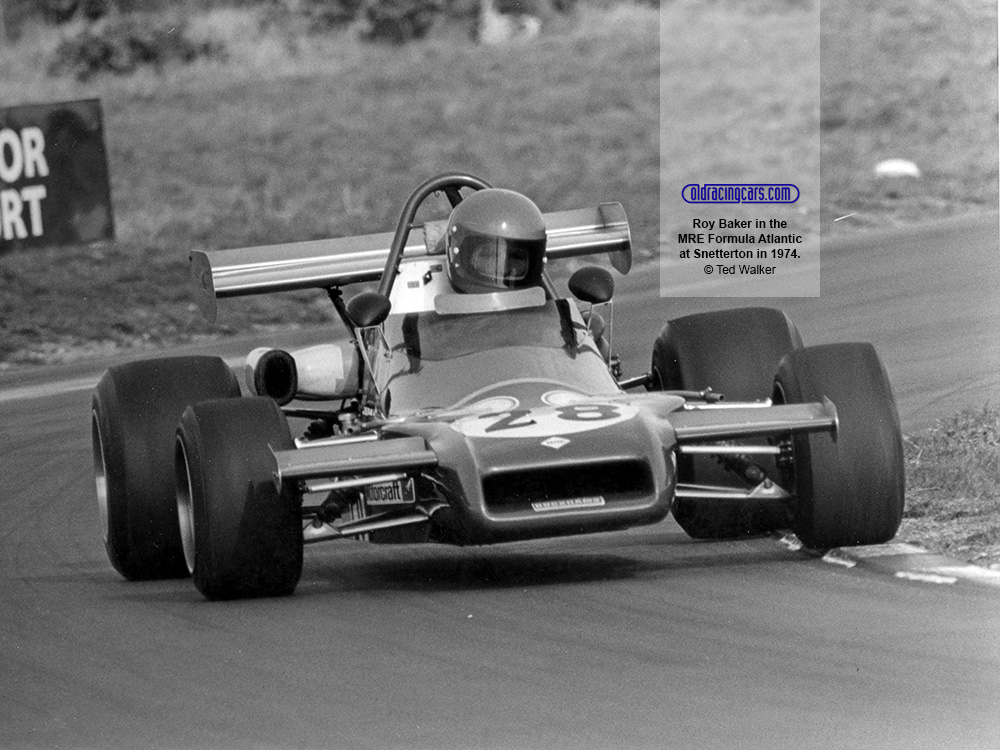
Roy Baker in the MRE Formula Atlantic at Snetterton in 1974. Copyright Ted Walker 2012. Used with permission.
New to Roy Baker (Ferndown, Dorset) and entered in the 1974 British Formula Atlantic series. The car was entered at first as a MRE Ford Hart 74, and later as a MRE 74F Hart, but 74F was the designation of MRE's Formula Ford car, and the correct name for this car is believed to be 74A. Baker's MRE was red, and usually entered at #28. He had a Hart engine for the first half of the season, and then a Racing Services unit later. Whether the engine was a BDA or a Ford twin cam is unclear, but as Baker had a BDA engine in his Lotus 69 the year before, a twin cam is highly unlikely. He was about 10% off pole position time at his first appearance, at Silverstone in late March, and finished ninth. He was also well off the pace at his other races, peaking at 5% slower than pole at Silverstone in May, where he qualified 12th out of 17, but later over 30% slower at Brands in late September. His best result came in a Formule Libre race at Silverstone in August where, despite being very slow again in practice, he had a good race to finish fifth. That turned out to be Baker's last start in the MRE, and in mid-September MRE (Racing Services) Ltd advertised it for £2,250 less engine. Baker acquired a March 722/73B towards the end of 1974, and his performances improved in 1975. The subsequent history of the MRE 74A is unknown.
Driven by: Roy Baker. First race: Silverstone (R1), 31 Mar 1974. Total of 8 recorded races.
MRE becomes Tiga - 1975 to 1976
MRE continued to produce Boxstrom-designed Formula Ford 1600 and Formula Ford 2000 for 1975. By this time it was only assembly that was taking place at Gleave's Bourne End premises. The chassis frames were built by Bill Stone at Sabre Automotive, the company he had co-founded with Adrian Reynard after Stone left March Engineering in 1971. The MREs' bodies were by FKS Fibreglass Mouldings Ltd in Poole (later Griffin Design), run by "the other" Jim Clark, formerly a designer with Lotus and then head stylist at Specialised Mouldings where he designed the bodywork for Lola T70 and the McLaren M6GT, and helped Derek Bennett style the Chevron B16. Stone was a Kiwi, as was Clark, and another Kiwi plus an Australian were now added to the mix.
At the end of 1975, Gleave sold MRE's racing car manufacturing side to Howden Ganley and Tim Schenken as the basis of their new Tiga company. The operation was moved to Ganley's premises at the same 361 Bath Road address used by Boxstrom's Competition Wheels. Design engineer Martin Read was given the job of "tidying up" the MRE designs to market as Tigas in FF1600 and FF2000 in 1976. Read, who was given the nickname "Cream Bun" by Harvey Postlethwaite while working at Wolf-Williams, had worked on Ganley's abortive F1 car project and had most recently worked with Patrick Head on the Wolf project. He would go on to work at BS Fabrications, Dallara, McLaren, TWR Jaguar, Ford, Reynard and Panoz. Tiga expanded into sportscars, first in Sports 2000 in 1977 and later Group C, so outside the scope of this website, but it is interesting to note that Roy Baker became one of Tiga's most faithful customers.
Acknowledgements
What little has been discovered about this car comes from race reports in Autosport, and entry lists. Background on MRE is also from Autosport. Thanks to Richard Page of the Formula One Register and Chris Townsend for sharing what they knew about this car, and to Simon Hadfield for useful context.
If you can add to our understanding of these cars, or have photographs that we can use, please email Allen at allen@oldracingcars.com.
These histories were last updated on .