
Huffaker 1966 Indy car-by-car histories
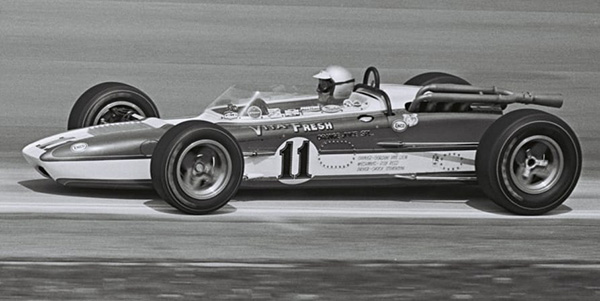
Chuck Stevenson in #11 Vita-Fresh Orange Juice Huffaker at the Indy 500 in 1966. Licenced by The Henry Ford under Creative Commons licence Attribution-NonCommercial-NoDerivs 2.0 Generic. Original image has been cropped.
Joe Huffaker produced four new cars for 1966, two for Kjell Qvale's team for Bob Veith to drive and two for Gordon Van Liew's team and driver Bobby Unser. The car proved to be a complete disaster in 1966 but two of the cars later achieved some success in sprint races.
The cars were built in the BMCD competition department at 45 Duffy Place, San Rafael, CA, by Joe Huffaker and his team, so some authorities would see these as BMCs or MGs, even though they were more commonly called Huffakers. Indeed, when the car first appeared at the Speedway for a test in mid-March, George Moore in the Indy Star referred to the car as a Huffaker. Unlike the 1964 cars, the new Huffakers were of monocoque construction, similar in Huffaker's words to airplane construction. The car was six inches narrower than the 1964 car, an inch lower and two inches longer. The BMC Hydrolastic suspension was retained, derived from Alec Issigonis’s BMC road car system, but some American reports credited the liquid suspension to Huffaker, commenting that it was such a fine discovery by Huffaker that it was used on MG road cars!
Huffaker's customers for the cars were BMC importer Kjell Qvale (pronounced 'Shell Cavalli') to be run as MG Liquid Suspension Specials and two for Gordon Van Liew, owner and founder of Cal-Tex Citrus Juice, Inc., makers of Vita Fresh Fruit Juices who sponsored the cars. The first car produced was for the Vita Fresh team but driver Bobby Unser damaged the car in a test at Phoenix on 20 March. The #67 for Kjell Qvale was the third car built, being completed on 29 April, and was fitted with a supercharged Offy engine, while the other MG Liquid Suspension Special would be powered by a Hillborn-injected 305 ci Chevrolet engine built by Huffaker. At the Indy 500, the Vita Fresh team had their #7 entry for Unser fitted with a supercharged Offy engine, while the #11 car for Chuck Stevenson started practice with a normally-aspirated Offy.
Despite the best efforts of Bob Veith and his chief mechanic Buster Warke, neither of the MG Liquid Suspension Specials were ever on the pace during practice. Veith suffered a fire in the Offy-engined #67 entry and spent most of his time in the Chevrolet-engined #63, but both his qualifying attempts were waved off. Bob Christie made a last minute attempt to nurse speed from the #63, but to no avail. Qvale immediately wound up his Indy car operation, and his BMC competition department was sold to Huffaker. The Vita Fresh team also struggled with the supercharged Offy in their #7 car so during the month fitted one of the first of the very new 168 ci turbocharged Offy engines to the #11 car. Unser took over that car, demoting Stevenson to the #7. Despite the Huffaker's handling problems, Unser was able to use the power of the turbocharged Offy to qualify the #11 car on the penultimate row of the grid and was classified eighth in the race despite being 29 laps behind at the finish. Stevenson was unable to qualify the supercharged #7 car.
If you can add to our understanding of these cars or have photographs that we can use, please email Allen at allen@oldracingcars.com.
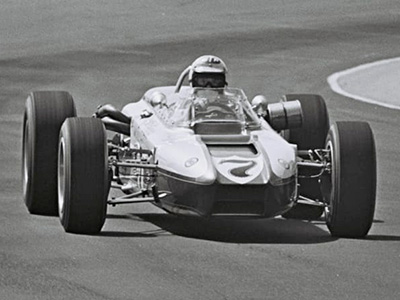
Bobby Unser in #7 Vita-Fresh Orange Juice Huffaker at the Indy 500 in 1966. Licenced by The Henry Ford under Creative Commons licence Attribution-NonCommercial-NoDerivs 2.0 Generic. Original image has been cropped.
New to Gordon Van Liew's Vita-Fresh Orange Juice team (Houston, TX) as the #7 entry for Bobby Unser in 1966, first appearing at the Indy 500. Unser's car was initially fitted with a supercharged Offy, while Chuck Stevenson's team car had a normally aspirated unit. Both cars had engine problems and Stevenson's was fitted with a turbo Offy. When Unser was unable to get the supercharged #7 up to speed, he took over Stevenson's turbocharged #11 and qualified that car. Stevenson was unable to qualify the #7. Unser finished 8th in the race. He then raced his original #7 at Milwaukee and Langhorne in June. The car was then "lost in a highway accident" and Van Liew replaced it with a Gerhardt-Ford. In March 2018, James Long mentioned on Facebook that "the remains of Bobby Unser's 1966 Huffaker Indy car [had been] fittingly discovered in Rough n Ready CA". (Rough and Ready, California, is a tiny settlement about 60 miles northeast of Sacramento, CA.) The bottom of the #7 was clearly visible on the side of the car, suggesting it was untouched since its alleged road accident. Long restored the car as the sister #11 Huffaker over the next year. In May 2019, it was on display at the Indianapolis Historic Racing Exhibition, then owned by Scott Borchetta.
Driven by: Bobby Unser and Chuck Stevenson. First race: Milwaukee Mile (R4), 5 Jun 1966. Total of 2 recorded races.
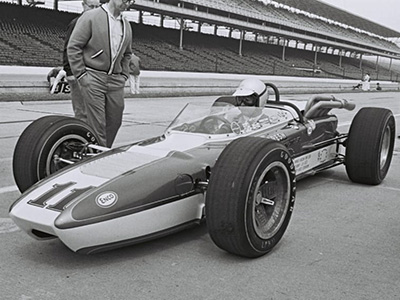
Chuck Stevenson in #11 Vita-Fresh Orange Juice Huffaker at the Indy 500 in 1966. Licenced by The Henry Ford under Creative Commons licence Attribution-NonCommercial-NoDerivs 2.0 Generic. Original image has been cropped.
New to Gordon Van Liew's Vita-Fresh Orange Juice team (Houston, TX) as the #11 entry for Chuck Stevenson, first appearing at the Indy 500. Stevenson's car was initially fitted with a normally aspirated Offy, but after engine problems on both his car and that of teammate Bobby Unser's, Stevenson's #11 Huffaker was fitted with a turbo Offy by chief mechanic Roy Reed. Just a day later, Unser took over the #11 for the last qualifying session and qualified for the race, leaving Stevenson to unsuccessfully attempt to qualify the supercharged #7. In mid-June, the #7 was destroyed in a towing accident, leaving Bobby Unser with only the #11 car. Unser left Van Liew's team part way through practice at Atlanta later that month, saying he did not trust the Huffaker. Joe Leonard drove the #11 at Atlanta, then Larry Dickson was employed by Van Liew for the rest of the season. He preferred the new Gerhardt that Van Liew had bought, and the Huffaker was driven later in the season by Sammy Sessions and Ronnie Duman. Van Liew then bought a Lotus 38 for 1967, and the Huffaker was not used again. It was next seen in 1969, when it was raced by Ned Spath in CRA and USAC events, fitted with a Chevrolet V8 engine and entered as the #95 Topaz Equipment Spl by car owner Carl Alleman (Redondo Beach, CA). The car was first mentioned as an entry for Spath in JC Agajanian's CRA Open Competition event at Hanford on 9 Feb 1969, when it was described as the car in which Unser finished eighth at the Indy 500, and was said to be Spath's first outing in a rear-engined car. The car was also backed by Alleman's company Alcast Foundry. Photographs confirm that the car was a 1966 model. Spath continued to use the car in 1970 when the car was identified as being part of Pat O'Reilly's Minnesota Serendipity team, still supported by Topaz Equipment, and appeared at least once in 1971 when he failed to qualify at Phoenix in March. The car was next mentioned in early 1972 when USAC News reported that it had been fitted with a "Turbo-Dome" rotary engine designed by Roger and Randall Hanson (Los Angeles, CA) with the intention of appearing in the USAC championship. Subsequent history unknown.
Driven by: Bobby Unser, Chuck Stevenson, Joe Leonard, Larry Dickson, Sammy Sessions, Ronnie Duman and Ned Spath. First race: Indianapolis Motor Speedway (R3), 30 May 1966. Total of 8 recorded races.
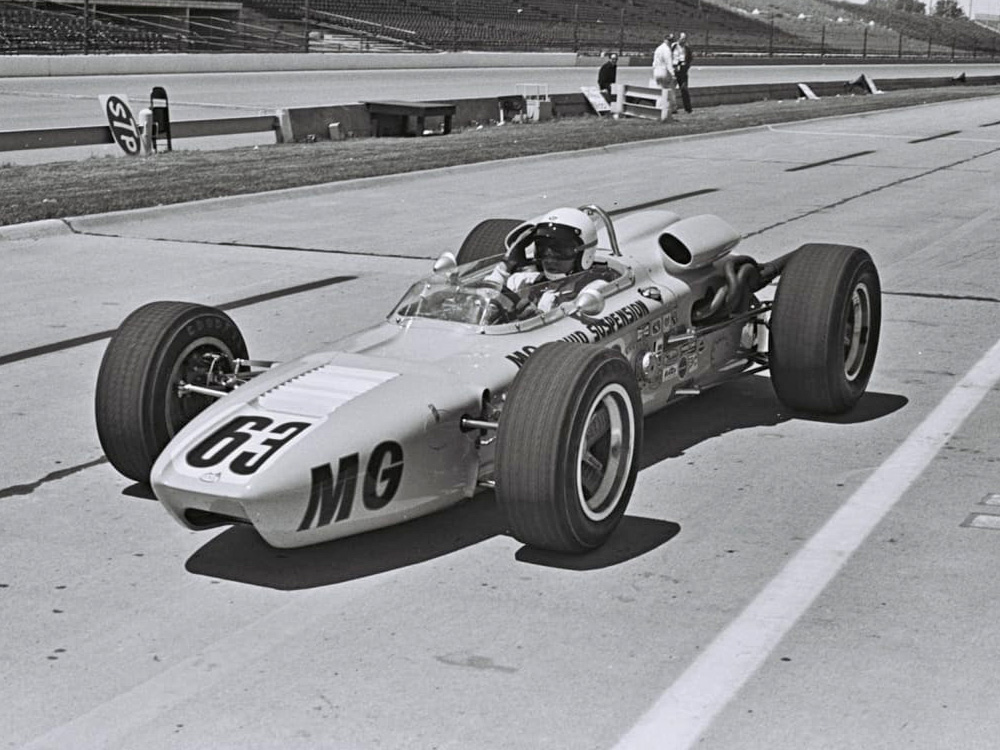
Bob Veith in Kjell H Qvale's #63 MG Liquid Suspension Huffaker at the Indy 500 in 1966. Licenced by The Henry Ford under Creative Commons licence Attribution-NonCommercial-NoDerivs 2.0 Generic. Original image has been cropped.
New in 1966 for Kjell H Qvale's MG Liquid Suspension team and entered at the 1966 Indy 500 as the #63 car with a Chevrolet stock block engine. Bob Veith had the choice of this yellow car and its Offy-powered #67 black sister car. When Veith settled on the #67 car, Masten Gregory was given the chance to qualify the #63 Chevrolet car, but he was dropped again when Veith changed his mind. Veith eventually made two qualifying runs in the #63, but was off the pace and he was waved in. Qvale did not continue with the cars. Subsequent history unresolved but see 'the Ed Marshall car'.
Driven by: Bob Veith and Masten Gregory. First appearance: Indianapolis Motor Speedway (R3), 30 May 1966.
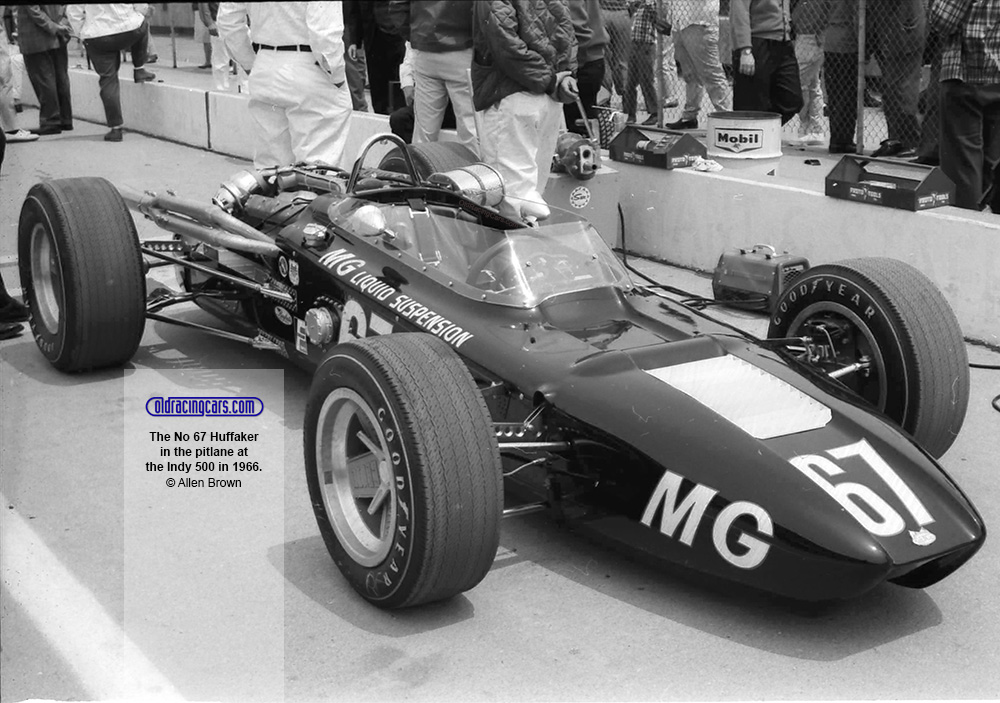
The #67 MG Liquid Suspension Huffaker in the pitlane at the Indy 500 in 1966. Copyright Allen Brown (slide acquired on eBay) 2026. Used with permission.
New in 1966 for Kjell H Qvale's MG Liquid Suspension team and entered for Bob Veith to drive at the 1966 Indy 500 as the #67 car with a supercharged Offy engine. The veteran Veith had problems with the supercharged engine and after the car was damaged by an engine fire, he spent much of his time during practice in his #63 Huffaker with Chevrolet engine. The supercharged engine in the #67 was swapped for a normally aspirated Offy before the final weekend of qualifying, but that did not work either and Veith swapped back again to the #63. In a hectic final hour of qualifying, veteran Bob Christie was employed to drive the #67 but nothing chief mechanic Buster Warke did to it made it any quicker. Like the #63, it failed to qualify. Qvale did not continue with the cars. Subsequent history unresolved but see 'the Frank Fiore car'.
Driven by: Bob Veith and Bob Christie. First appearance: Indianapolis Motor Speedway (R3), 30 May 1966.
The Fate of the #7 Huffaker
After the Indy 500, Bobby Unser drove the Vita Fresh team's #7 car at two races at Milwaukee and Langhorne, but qualified well down the grid and retired early from both. At this point, the #7 car appears to have been wrecked in an accident, mentioned by Unser in an interview in Racer magazine in 2018. He said that a 'Norm Shoop' somehow "drove the whole rig" off a cliffside at Salt River Canyon as it was being taken back to Albuquerque. Why the car would have been southwest of Albuquerque on its way from Langhorne is not clear, but maybe this incident occurred when returning from a test at Phoenix, when an incident on the winding road where Route 60 crosses the canyon is more understandable. The next race for the team was at Atlanta on 26 June, where the team had the #11 car, but Unser left the team halfway through practice, saying he could not trust the car. Joe Leonard stepped into the Huffaker for that race, and then Larry Dickson got the ride for the rest of the season. The #7 Huffaker did not reappear, and when Dickson later drove the team's #7 entry, it was a 1966 Gerhardt. The #7 Huffaker reappeared in 2018, damaged and still in its 1966 paintwork. It is important to note that the #7 and #11 cars had quite different paintwork, with the orange and white bands swapped between the cars, and that the #11 had a wide black rollhoop, very different to the plated rollhoops on the #7 and on Veith's #63 and #67.
Huffaker Automotive Engineering
At the end of June 1966, it was announced that Joe Huffaker had bought a share of the "British Motors Competition Department" from Qvale and it would become an independent organisation called Huffaker Automotive Engineering. The new outfit planned to race the 1966 Huffakers in the USAC series for the rest of the season and selected Dave Ridenour as lead driver. Unfortunately, Ridenour was killed in a minor dirt track race just three days later.
The Huffaker operation advised the press that it built more race cars than any other manufacturer in the US and was "one of the largest in the world", describing Huffaker as the "guiding genius" behind the 1966 Indy cars. Rumours were floated that Jochen Rindt would drive Huffaker's car at the 1967 Indy 500. Mickey Thompson bought into all this and commissioned Huffaker to build his 1967 Indy car, complete with four-wheel steering and an almost immediate meeting with the wall when it tested at Phoenix. Neither of the barking mad 1967 cars worked, and neither even managed to start a race.
The 1966 Huffakers in later life
Only one of the four 1966 cars remained in use even to the end of the 1966 season, and none of them were seen in 1967. The first to reappear was Frank Fiore's for Chuck Booth at the 1968 Indy 500, but Booth's immediate reaction was that it was not safe to drive. The second was Carl Alleman's for Ned Spath in early 1969, and the third was Ed Marshall's, which appeared in 1969 and 1970. The absent fourth would be the #7 car that had been rendered hors de combat at the Salt River Canyon.
The identification of the three reappearing cars is confident but not completely certain. The 1970-71 CRA Yearbook had a photograph of Spath on the Alleman car at Hanford in February 1969 and mentioned that it was the ex-Vita Fresh car that finished eighth in the 1966 Indy 500. If we rely on that to be correct, then the Fiore and Marshall cars must have been the former MG Liquid Suspension Specials, the yellow #63 and the black #67. Frank Fiore Jr commented on Facebook in March 2016 that his father's car "was a Black #67" acquired from Joe Huffaker. If both of those are correct, Marshall's car would have to be the yellow #63.
It is noteworthy that both the Fiore and Marshall cars had outboard suspension all round when they reappeared. Marshall's changes were credited to Nade Bourgeault.
In 1968, Frank J. Fiore brought a 1966 Huffaker to the Indy 500 for Chuck Booth to drive, entered as the #34 Speedy's Broasted Chicken Spl. Booth stepped out of the car on 13 May, saying that it was not safe to drive, and was replaced by Dee Jones. Jones started his refresher test in the car but had to withdraw after two laps due to engine problems, and that was the last that was heard of the car that month. Jones was entered at Milwaukee on 9 June but was too slow to start the race. George Benson qualified the car at Hanford in December, but retired with a seized engine. Fiore entered Johnny Parsons Jr in the car for the 1969 Indy 500, but he was refused a rookie test due to inexperience, so the drive went to midget racer Dave Strickland. The car was unable to get up the speed necessary to get Strickland through his rookie test.
The car was then sold to Carl Gehlhausen (Jasper, Indiana) for his driver Tom Bigelow, then doing very well in Gehlhausen's #84 sprint car, prepared by mechanic Eddie Baue. The Huffaker was entered as the #34 Midwest Manufacturing car for Bigelow for a number of USAC races in 1969, 1970 and early 1971, all without success. It was then converted by Gehlhausen to run in the USAC Sprint Car series. At the opening paved-track event, at Salem in March, driver Larry Dickson was uncompetitive, and Sammy Sessions also struggled when he tried it. Duke Cook then tried it at Tri-County Speedway in mid-April, but hit the wall. Tom Sneva then took over the car, and in July 1973, won races at Toledo, Hartford and New Bremen Speedways. Three more wins followed in August and September, and in October USAC responded by banning all rear-engined cars from sprint racing with immediate effect. Gehlhausen sued USAC, but lost, and the Huffaker was not seen again. By 1990, it was in Chuck Haines' collection in St Louis, MO.
Driven by: Chuck Booth, Dee Jones, George Benson, Dave Strickland, Tom Bigelow, Larry Dickson and Tom Sneva. First race: Hanford Motor Speedway (R26), 3 Nov 1968. Total of 20 recorded races.
Ed Marshall (Kentfield, CA) entered a Huffaker for Indy races in late 1969, using a Chevrolet engine and entered by County of Marin at #75. It was called a Huffaker when entered for the Seattle race in October, then an Eisert at the Bobby Ball 200 at Phoenix four weeks later, where Marshall failed to qualify. He finally started a race at Riverside in December but was an early retirement when the car lost a wheel. Photographs show that the Huffaker now had outboard springs all round, a major change from its 1966 specification. It had been updated by Nade Bourgeault, who had previously worked with Huffaker on the BMC Formula Junior cars before building his own single-seaters for Formula B and Formula C. Marshall had raced one of Bourgeault's creations in Formula B in 1969. Marshall's only known appearance in 1970 was at Sears Point in April, where he failed to start due to a failed oil pump drive. Marshall then raced the Huffaker in USAC's Seafair "200" road race in August 1971. It was also entered for the Bobby Ball 150 at Phoenix later that year, but did not appear. Later in November, Marshall advertised the car as a "USAC Championship car or Formula 5000" with "Huffaker tub" and "Bourgeault suspension". It was fitted with a "very expensive" 305 ci Chevrolet V8 engine. Subsequent history unknown.
Driven by: Ed Marshall. First race: Riverside (R24), 7 Dec 1969. Total of 4 recorded races.
Acknowledgements
My thanks to Michael Ferner, Simmo Iskül, 'gbl', Gerry Measures, Ian Blackwell and self-proclaimed 'real anorak' Tom Schultz. I am also grateful to James Long for his Facebook posting about his discovery of the #7 car and to Frank Fiore Jr's postings about his father's car. Race results for Sneva in the USAC Sprint Car series are from Timothy Quievryn's very impressive The Third Turn.
If you can add to our understanding of these cars or have photographs that we can use, please email Allen at allen@oldracingcars.com.
These histories were last updated on .